
Updated: July 2026
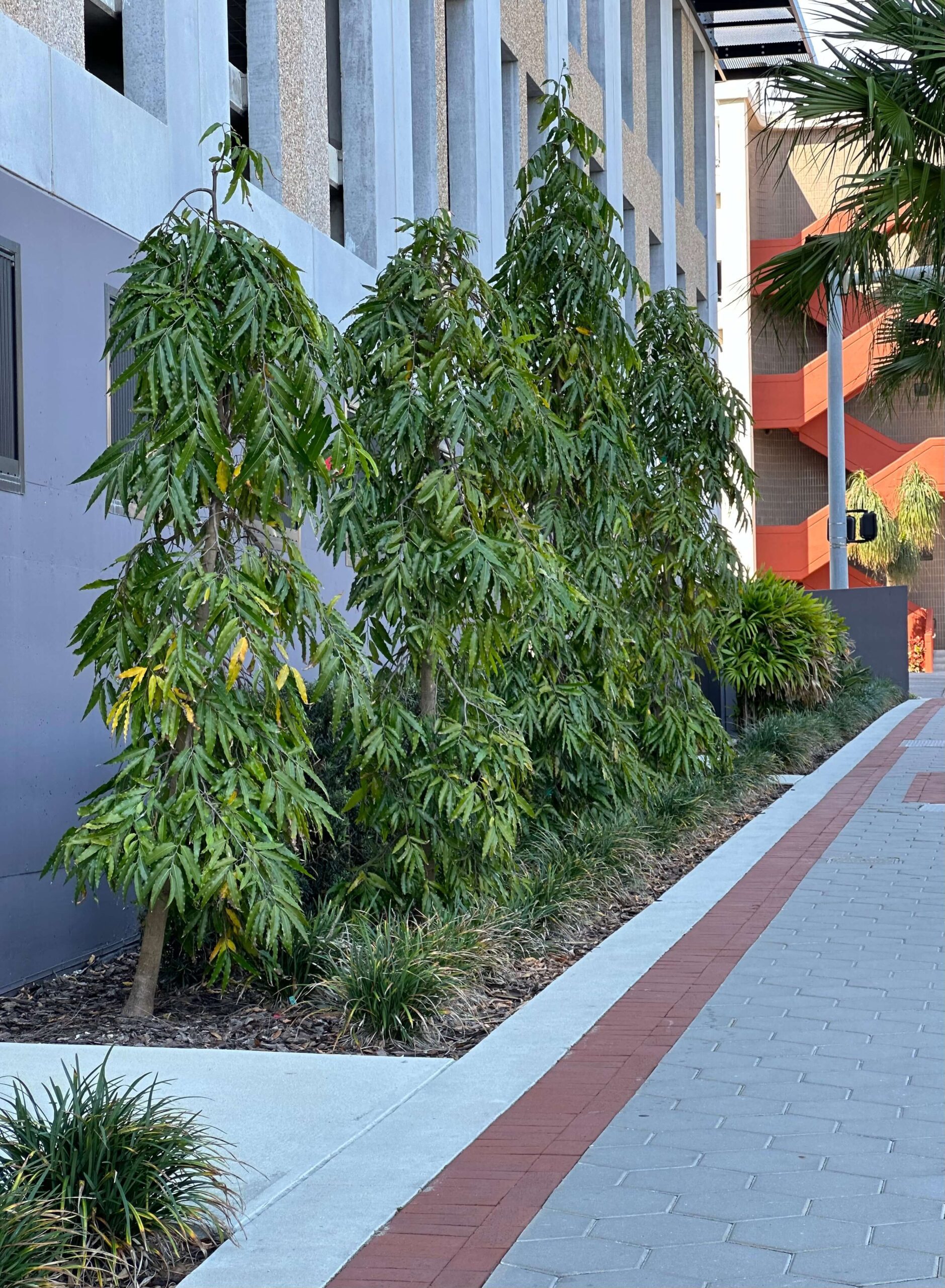
Quick Facts
- Common Name: Mast Tree, False Ashoka, Indian Fir, Cemetery Tree, Buddha Tree
- Scientific Name: Polyalthia Longifolia “Pendula”
- Drought Tolerance: Moderate to High
- Origin: India
- Zone: 10a – 11
- Typical Height: 30 – 45 feet
- Typical width: 3 – 6 feet
- Salt Tolerance: Moderate
- Growth Rate: Moderate
- Light Needs: Full to partial sun
- Soil/pH/Texture: Prefers well-draining, loamy soil, neutral, pH 5.5-7.5
- Wildlife: Bats and birds eat the fruit, pollinators are attracted to the flowers
- Watering Requirements: Average until established
- Pests/Diseases: No pests or diseases are of strong concern
General Interest
The Mast Tree is native to India and Sri Lanka. It became popular because its tall, straight trunk and lightweight, flexible wood made it ideal for a ship’s mast. The wood is a yellowish to grey white color with a medium weight and low natural resistance to rot and decay. It is also suitable for making pencils and matches.
The botanical name Polyalthia comes from the Greek word “poly,” meaning many, and “althia,” meaning cure. There is not, however, widespread use of the plant for medicinal purposes.
These beautiful evergreen trees are columnar in shape and covered from bottom to top with glossy, lance shaped dark green leaves on drooping branches. In spring, clusters of pale yellow-green star-shaped flowers bloom, followed by green fruit with a single seed that ripens to dark purple in summer and fall.
Why This Tree Has My Attention
I first came across the Mast Tree while researching tropical landscape options, and it has stuck with me ever since. It is tall and slender, almost architectural, and completely content to be left alone. It is not currently part of the landscape at Casa Rosa, but it is the kind of tree I find myself circling back to when I think about future planting.
Landscape designers throughout south and central Florida use Mast Trees for a wide range of purposes, including:
Florida Mast Trees are an eccentric tree to add to your landscape design. These trees are tall and slender, much like a model in a high-end fashion magazine, but totally content to be left alone. Landscape designers throughout south and central Florida are enjoying the versatility of Mast Trees for a wide range of uses as follows:
- Architectural accents
- Elegant entry frames
- Focal points
- Lining avenues or driveways
- Living hedges
- Privacy screens around pools
- Privacy barrier between houses
- Noise reduction
- Wind screens
- Height in Gardens
- Statement in a compact space
Casa Rosa Close
The Mast Tree is not part of the current Casa Rosa landscape, but it is exactly the kind of unique specimen I love thinking about as I plan what comes next for the property. For a look at what is actually growing and changing at Casa Rosa right now, see Mulch for Casa Rosa Landscaping: My Insider Guide and Casa Rosa Backyard and Pool Deck Remodel: My Insider Guide.
— izzy