
Updated: June 2026
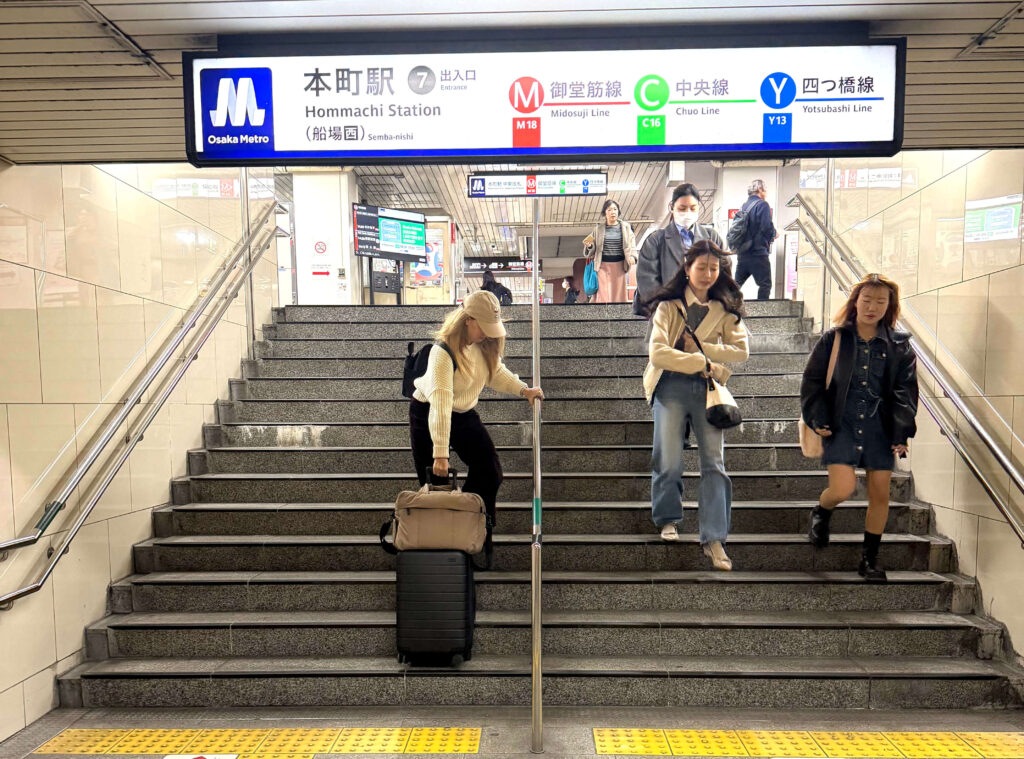
Traveling through Japan becomes instantly easier once you discover takuhaibin, the country’s famously efficient luggage forwarding service. Introduced in the 1970s as a general parcel courier system, it has since become one of the most useful and underrated travel tools in Japan.
We used it across our entire trip, forwarding our suitcases from Tokyo to Osaka, Osaka to Kyoto, and then all the way from Kyoto to our final Tokyo hotel even though we still had two nights in Hakone in between. Our bags arrived before we did every time.
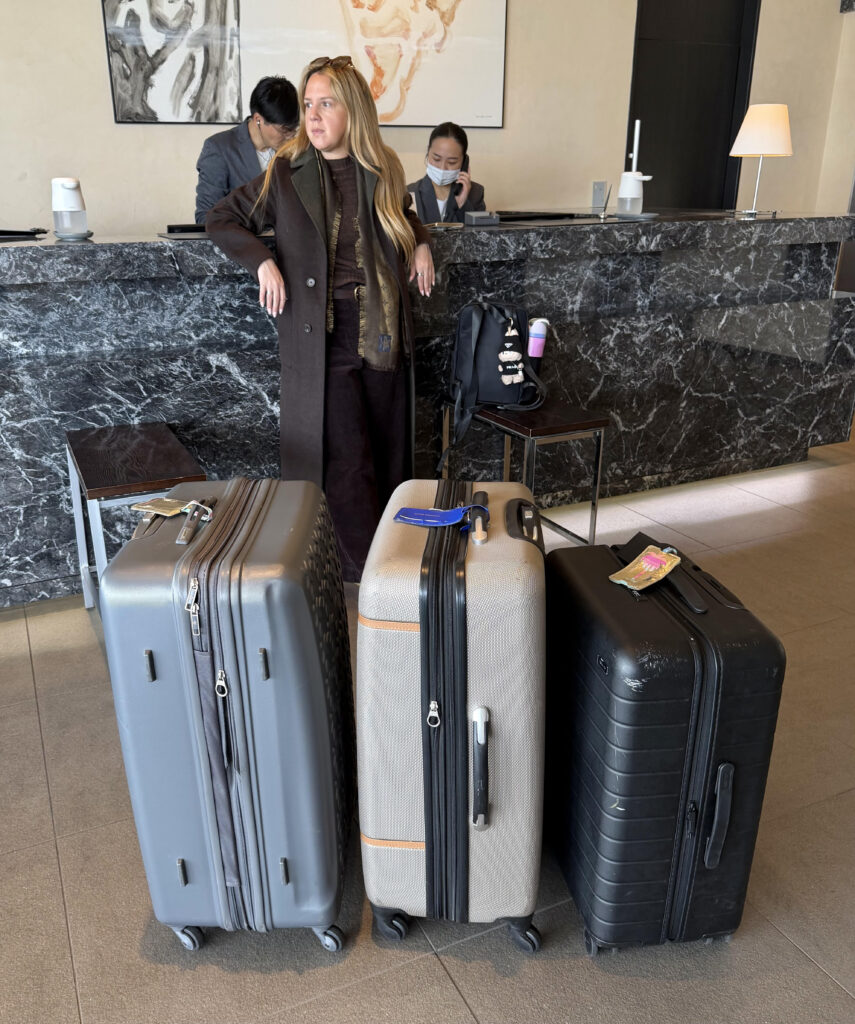
For roughly 2,100–3,200 JPY depending on size and distance you can ship a fully packed suitcase overnight to your next destination. Most hotels handle the entire process for you. You fill out a short form, hand over your bags at the front desk, and they take care of the rest.
If you want to move through Japan without wrestling suitcases through busy train stations, narrow streets, and packed Shinkansen cars, this is the service that makes it possible.
What is Takuhaibin
Takuhaibin is Japan’s baggage delivery service, a system that transports your luggage directly to your next hotel, airport, or destination while you travel unencumbered.
It is not a luxury add-on. It is a normal, widely used service relied upon by locals and visitors alike. Hotels, ryokans, and convenience stores like 7-Eleven and Lawson all offer luggage forwarding, and the process is straightforward enough that most travelers use it multiple times per trip without a second thought.
Your only job is getting yourself from point A to point B, free of weight, free of stress, and free to actually enjoy the journey.
Why Use Takuhaibin
Japan’s trains are extraordinarily efficient, but they were not designed with multiple large suitcases in mind. Overhead racks on the Shinkansen are small, and the designated luggage areas at the end of each car fill up quickly during busy travel seasons.
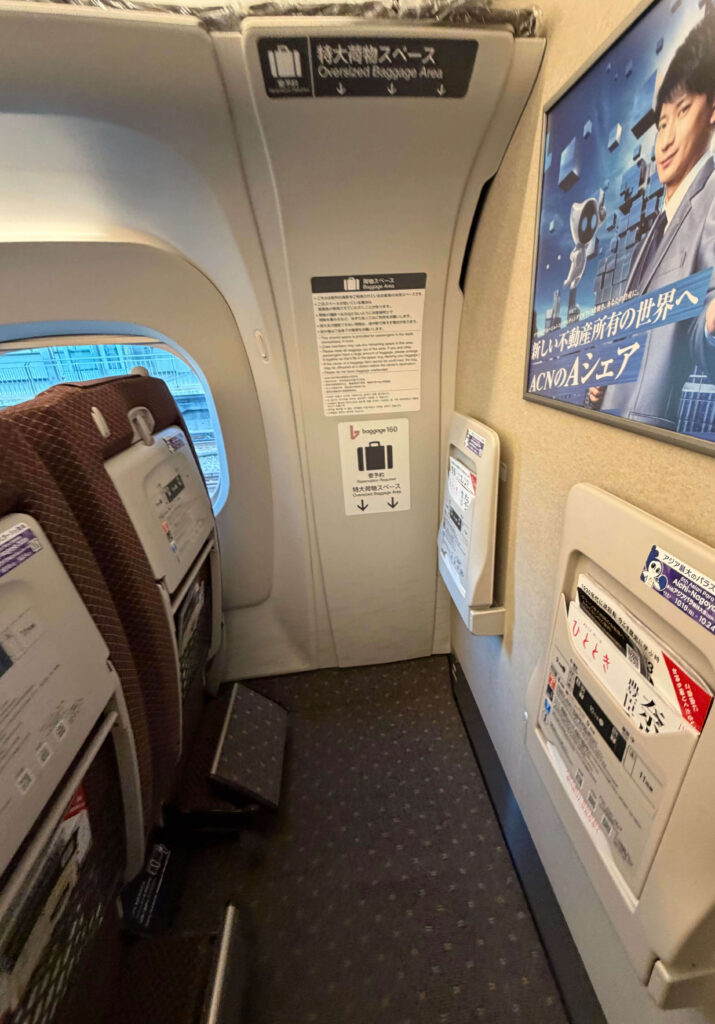
In 2020, JR implemented new rules for oversized luggage on certain Shinkansen routes. Bags measuring 161–250 cm in total dimensions require a reserved oversized luggage seat or storage space. Luggage over 250 cm is not permitted on the Shinkansen at all. Reservations can be made online when booking your tickets, or at JR station ticket machines and counters.
Even without oversized bags, navigating Japan’s train stations is a workout on its own. The staircases are steep, the platforms are crowded, and the distances between connections are longer than they look on a map.
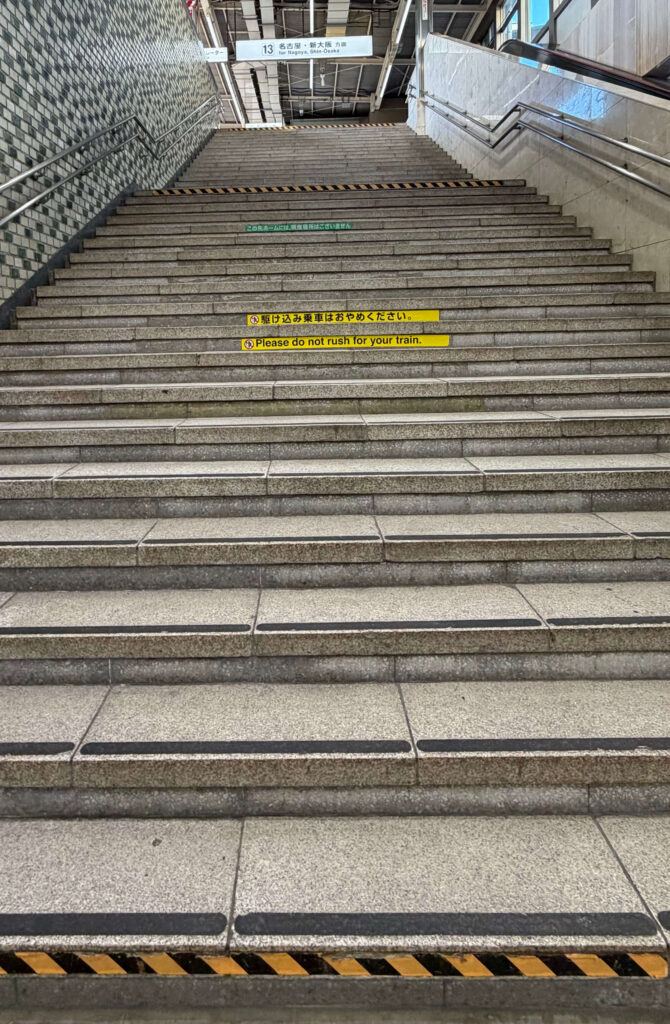
Forwarding your luggage means traveling with nothing more than a carry-on. We relied on our AWAY The Bigger Carry-On for travel days, and it changed the experience entirely.
Our Experience
We forwarded our luggage three times across our trip, and it worked flawlessly every time. Here’s exactly how it played out:
Tokyo → Osaka We forwarded our suitcases from The Gate Hotel Asakusa Kaminarimon to the St. Regis Osaka before boarding the Shinkansen. We paid approximately $50 to forward three suitcases. Our luggage was waiting at the St. Regis when we arrived.
Osaka → Kyoto From the St. Regis Osaka to the Hyatt Regency Kyoto. We paid approximately $50 to forward three suitcases. Same seamless experience — bags at the hotel before we checked in.
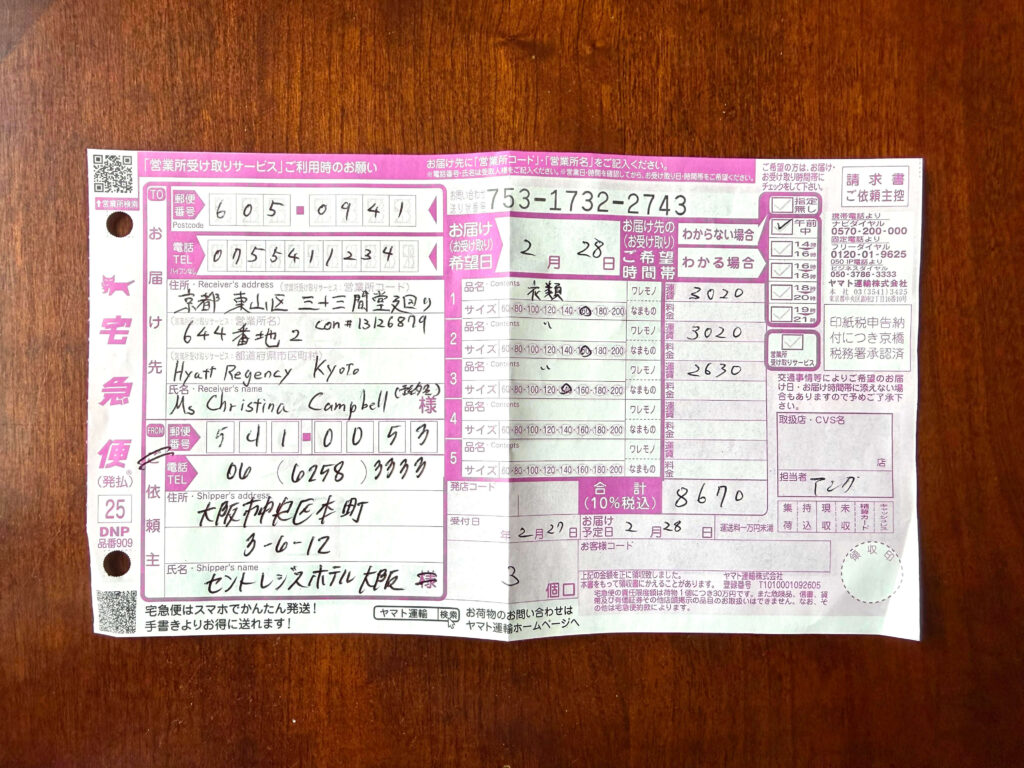
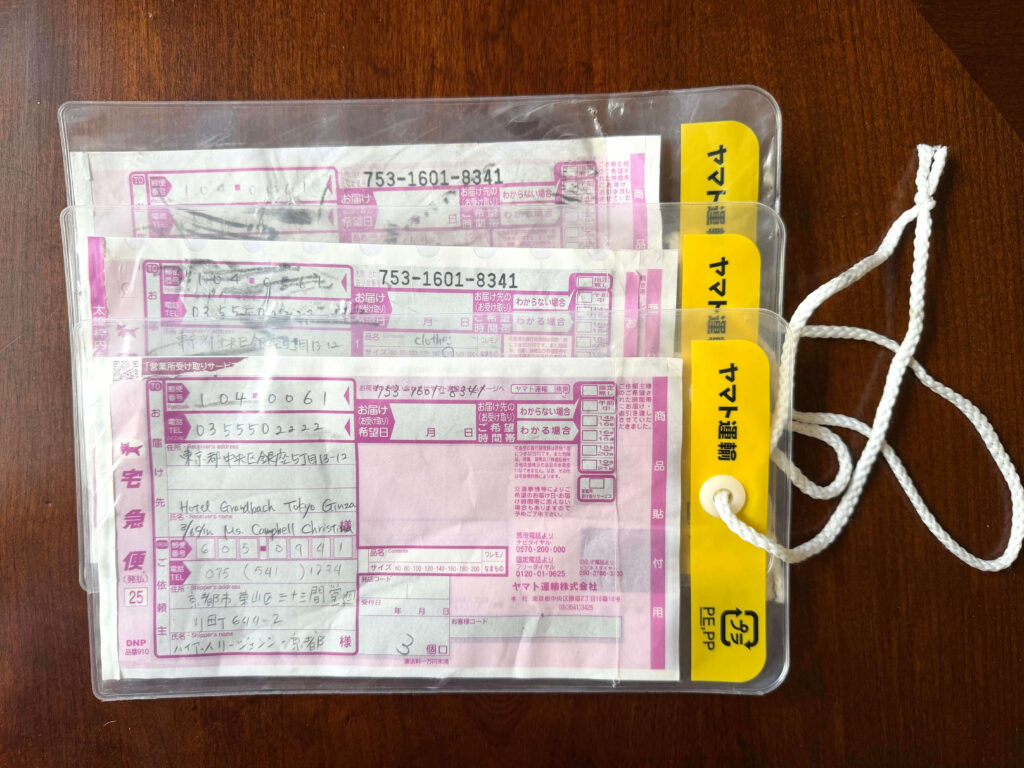
Kyoto → Tokyo This leg shows just how flexible the service is. We forwarded our suitcases from the Hyatt Regency Kyoto directly to Hotel Grandbach Tokyo, even though we still had two nights in Hakone ahead of us. Our bags traveled to Tokyo while we went to Hakone, and they were waiting at Hotel Grandbach when we arrived days later. We paid approximately $50 to forward three suitcases.
This website uses affiliate links which may earn a commission for purchases at no additional cost to you.
For our two nights at Laforet Hakone Gora Yunosumika we carried two small bags between us — the AWAY The Bigger Carry-On packed with toiletries, the previous night’s pajamas, and anything we needed for travel days. It rolls on a dime and handles everything a day bag needs without feeling like you’re hauling luggage. A Calpak for snacks, laptops, Kindle, magazines, and anything else we needed for the journey. Everything else went ahead to Tokyo with the forwarding service.
It’s the move for any ryokan or boutique hotel stay between forwarding legs, travel light, send everything ahead, and arrive unburdened.
Who Offers Luggage Delivery
Three main providers operate luggage forwarding services across Japan.
Airporter
Airporter is a newer, modern luggage delivery service offering same-day and next-day delivery between hotels, airports, and train stations in major travel hubs. Unlike traditional courier services it focuses on speed and convenience for travelers with tight schedules or multiple accommodation changes.
Airporter currently operates in Tokyo, Osaka, Kyoto, Hokkaido, and Okinawa. Same-day delivery is available as long as luggage is dropped off before the daily cutoff, usually around 11:00 AM. Drop-off and pick-up points include participating hotels, airport counters, and select train stations.
JAL ABC
JAL ABC is especially popular for airport-bound travelers who want to check out of their hotel and enjoy their final day in the city without dragging suitcases through the streets. The service covers luggage delivery between hotels, airports, and even between airports, and also offers rental Wi-Fi, SIM cards, and temporary storage, making it a useful one-stop resource before or after a flight.
JAL ABC counters are available at major international airports across Japan, and some hotels are registered partners for smooth drop-off and pickup.
Kuroneko Yamato
Kuroneko Yamato, instantly recognizable by its Black Cat logo, is Japan’s most trusted and widely used luggage forwarding provider. Under its TA-Q-BIN service, travelers can ship suitcases, backpacks, sports equipment, and parcels between airports, hotels, and private accommodations anywhere in the country.
Yamato counters are available at major airports including Narita, Haneda, Kansai, and Chubu, as well as at 7-Eleven, FamilyMart, and Lawson locations nationwide. Most deliveries arrive within a day in urban areas while remote destinations may need an extra day.
If you’re staying in an Airbnb or anywhere without a front desk, simply drop your luggage at a partnered convenience store and they’ll forward it to your next destination. Yamato’s interactive online map helps you locate the nearest participating location.
How Much Does It Cost
Luggage forwarding in Japan is affordable — often surprisingly so.
Standard Suitcases (up to 160 cm total dimensions)
| Service | Price (JPY) | Price (USD approx.) |
|---|---|---|
| JAL ABC | ¥2,100–¥2,500 | $13.50–$16.00 |
| Kuroneko Yamato | ¥3,100–¥3,200 | $19.80 |
Oversized Luggage (170–200 cm total dimensions)
| Service | Price (JPY) | Price (USD approx.) |
|---|---|---|
| JAL ABC | ¥2,600–¥3,200 | $16.60–$20.50 |
| Kuroneko Yamato | ¥3,500–¥4,500 | $22.40–$28.80 |
Based on an approximate exchange rate of ¥1 = $0.0064 USD
For context, we paid approximately $50 for three bags. For what it saves in stress and physical effort, it is one of the best value travel expenses in Japan.
Kuroneko Yamato vs JAL ABC — A Quick Comparison
| Feature | Kuroneko Yamato | JAL ABC |
|---|---|---|
| Size Limit | Up to 160 cm | Up to 160 cm |
| Weight Limit | Up to 25 kg | Standard suitcase size |
| Delivery Areas | Nationwide | Major airports and partnered hotels |
| Delivery Speed | Usually next-day in cities | Usually next-day in cities |
| Best For | Maximum coverage and flexibility | Airport-to-hotel transfers |
The Waybill and What to Expect
When you use a luggage forwarding service in Japan you’ll receive a waybill, the shipping slip attached to your bag. The form is mostly in Japanese, but in practice you will almost certainly never need to fill it out yourself. Hotel staff, airport counters, and convenience store employees complete it for you.
At every hotel on our trip, The Gate Hotel Asakusa Kaminarimon, the St. Regis Osaka, and the Hyatt Regency Kyoto, the front desk handled everything. We confirmed the delivery date, received a tracking number, and handed over the bags. That was it.
If you ever do need to fill one out independently, here’s what each section means:
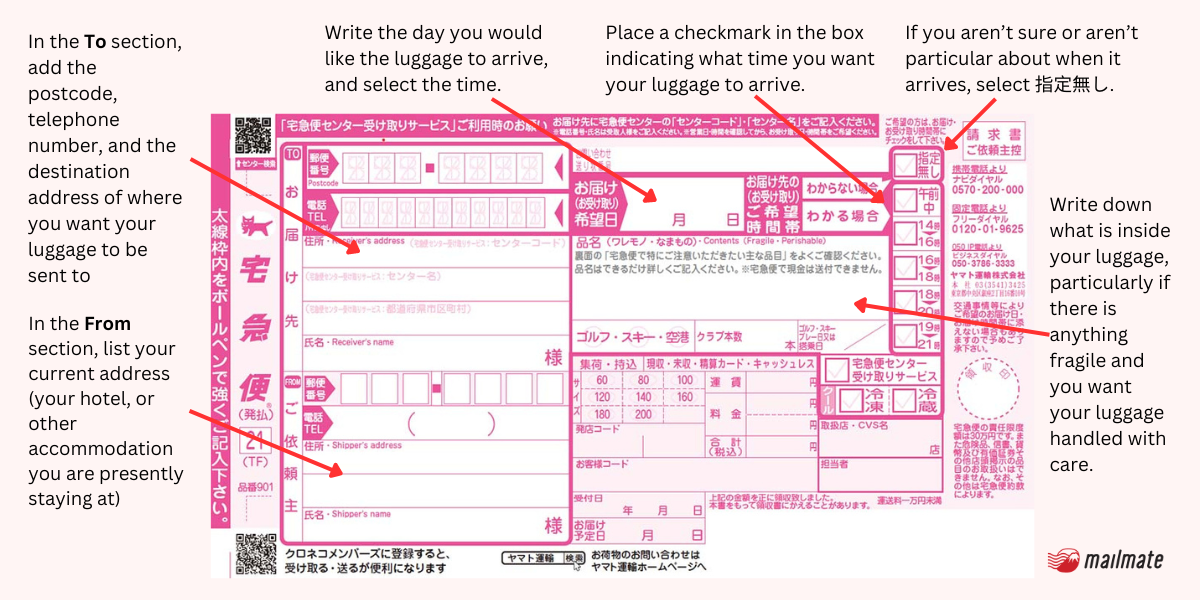
| Field | Japanese Label | What to Write |
|---|---|---|
| Name | お名前 / 名前 | Your full name (English is fine) |
| Phone Number | 電話番号 | Hotel phone number or your mobile |
| Destination Address | お届け先 / 住所 | Hotel or Airbnb address (ask staff to write it in Japanese) |
| Sending Address | ご依頼主 | Your current hotel or pickup location |
| Delivery Date | お届け日 | The date you want the luggage delivered |
| Time Slot | 時間帯 | Optional time window (morning/afternoon/evening) |
| Number of Items | 個数 | Number of bags |
| Luggage Type | 品名 | “Suitcase,” “Backpack,” etc. (English OK) |
| Payment Method | 支払い方法 | Staff will mark this |
If You Forget Something
Takuhaibin isn’t just for luggage. If you accidentally leave jewelry, a Kindle, a laptop charger, or a phone at your last hotel, don’t panic. Most hotels are happy to ship forgotten items to your next destination or directly to your home country for far less than the cost of replacing the item. Contact the hotel, provide the destination address, and they handle the packing and shipping.
Japan Close
Luggage forwarding is one of those travel discoveries that permanently changes how you move through Japan. Once you’ve arrived at a hotel to find your bags already waiting, you’ll never go back to hauling suitcases through train stations.
Pack your AWAY carry-on for the in-between days, send everything else ahead, and move through Japan the way it was meant to be experienced…lightly and freely.
— izzy